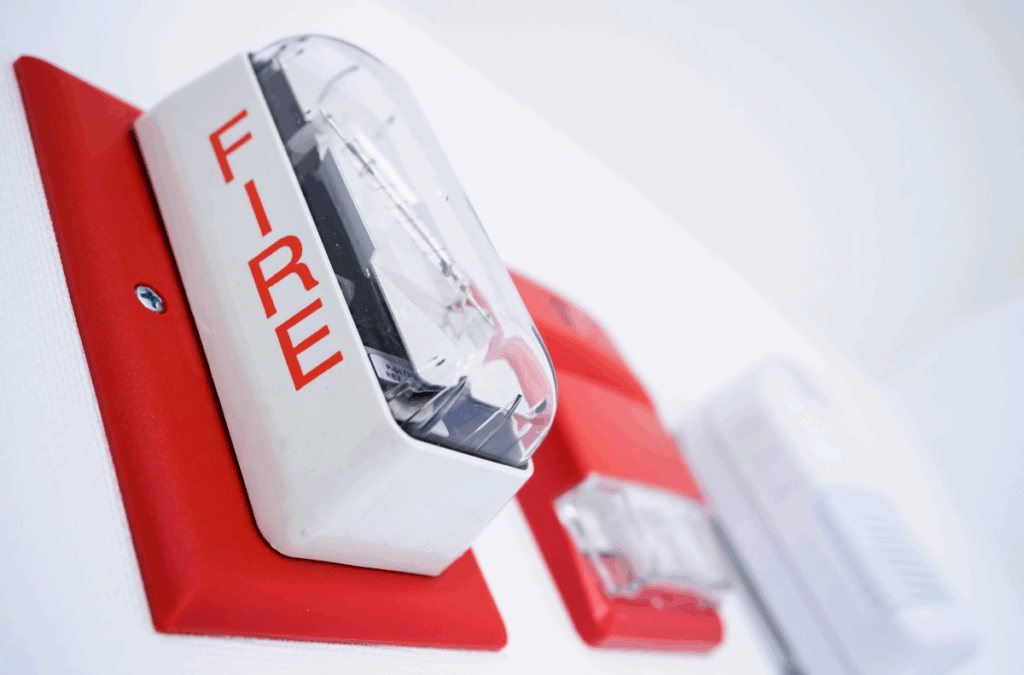
Fire alarm technology in 2026 has never been more sophisticated. That’s where commercial fire alarm monitoring comes in. It’s no longer just a best practice; for most commercial properties, it’s a legal requirement, a lease condition, and a cornerstone of any credible life safety strategy.
This guide breaks down what commercial fire alarm monitoring is, what codes require, how central station monitoring works, and what to expect when an alarm sounds.
Is Fire Alarm Monitoring Required?
Fire alarm monitoring requirements are established through a combination of national model building codes, state amendments, and local Authority Having Jurisdiction (AHJ) interpretations. The primary standards that drive most commercial requirements include:
- NFPA 72 (National Fire Alarm and Signaling Code): This is the foundational standard for fire alarm systems in the United States. NFPA 72 outlines when monitoring is required and what qualifies as an acceptable monitoring configuration. For most commercial occupancies, off-premises monitoring is mandated.
- NFPA 101 (Life Safety Code): Occupancy-specific requirements in NFPA 101 often trigger monitoring requirements based on building use, size, or occupant risk profile.
- International Fire Code (IFC) and International Building Code (IBC): Many jurisdictions adopt these model codes, which include monitoring requirements for a wide range of commercial building types.
- Local and State Amendments: Individual states, counties, and municipalities frequently layer additional requirements on top of the model codes. What’s optional in one jurisdiction may be mandatory in the next city over.
Beyond code compliance, fire alarm monitoring requirements are regularly embedded in:
- Insurance policy conditions: many commercial property carriers require monitored systems as a condition of coverage or premium discounts
- Commercial lease agreements: landlords and property managers commonly specify monitoring standards
- Occupancy permits: local fire marshals may require proof of a monitoring contract before issuing or renewing an occupancy permit
Always confirm your specific obligations with your local AHJ and a qualified fire protection professional.
What Is Central Station Monitoring?
Central station monitoring is the industry-standard method for providing off-premises supervision of fire alarm systems. When your building’s fire alarm panel detects a signal, it is then transmitted to a staffed facility called a central station, where trained operators respond according to established protocols.
A UL-Listed central station meets rigorous third-party standards set by Underwriters Laboratories, covering everything from physical security and redundant communications to operator training and response time benchmarks. UL Listing matters because many insurance carriers and AHJs specifically require it.
Central station monitoring provides several important functions in addition to receiving alarm signals:
Signal Supervision: Central stations continuously supervise the communications path between your fire alarm panel and the monitoring facility. If that connection is disrupted in any way, the central station is alerted and can intervene.
Trouble and Supervisory Signals: Modern fire alarm systems generate more than alarm signals. Trouble signals indicate a system fault such as a disconnected detector, low battery, or wiring problem. Supervisory signals indicate a monitored condition, like a closed sprinkler valve. Central station operators receive and act on all of these.
Multi-Path Communication: Contemporary monitoring setups typically use redundant communication paths (cellular, internet protocol, or radio) so that a single point of failure doesn’t leave your property unprotected. Your monitoring provider should be able to walk you through how your system communicates and what the backup paths are.
24/7 Staffing: A central station is staffed around the clock, every day of the year.
For a deeper look at what this service involves, Pye-Barker’s 24/7 Fire & Security Alarm Monitoring outlines what a professional monitoring relationship looks like in practice.
What Happens When an Alarm Signals?
When your monitored fire alarm system sends a signal to the central station, the sequence of events is well-defined.
Step 1: Signal Receipt and Verification
The central station receives the alarm signal and a trained operator immediately begins the response process. Depending on your account’s instructions and the signal type, the operator may:
- Attempt to contact the premises (calling your designated numbers) to confirm whether the alarm is valid or a potential false activation
- Cross-reference the signal type and zone information to assess the nature of the event
If contact cannot be made quickly or if the signal type indicates a confirmed life safety event, the operator moves directly to dispatch.
Step 2: Emergency Dispatch
The central station notifies the appropriate emergency services (fire department, EMS, law enforcement, or some combination depending on the signal) using the address and contact information on file. This notification is made to the public safety answering point (PSAP) or directly to the responding agency.
Central station monitoring promptly notifies emergency services. It does not guarantee a specific response time, and it does not replace the need for someone on-site to call 911 if they observe an active emergency.
Monitoring is a parallel safety net, not a substitute for direct emergency reporting.
Step 3: Notification of Responsible Parties
Alongside or following emergency dispatch, the central station contacts the individuals and organizations listed in your call list, which could be your facilities manager, property owner, security team, or designated keyholders. These notifications allow for on-site response, building access coordination, and business continuity decisions.
Step 4: Documentation
Every signal, every call, and every action taken is logged. This documentation is important for post-incident review, insurance claims, regulatory reporting, and identifying patterns that might indicate system issues.
Why Monitoring Matters More in 2026
Several trends are converging to make commercial fire alarm monitoring more important and capable than it has ever been.
Occupancy Complexity: Hybrid work models, shared-use facilities, flex spaces, and after-hours building access have made it less predictable whether anyone is present when an alarm activates. Monitoring confirms that an unoccupied building gets the same response as a fully staffed one.
Communicator Technology Transitions: The industry-wide sunset of traditional telephone lines has forced a migration to IP and cellular communicators. Facilities that haven’t updated their communication paths may have monitoring that is less reliable or that doesn’t meet current code requirements. This is worth verifying with your fire alarm service provider.
Insurance and Risk Management Scrutiny: Commercial property insurers are increasingly focused on life safety documentation. Having a UL-Listed monitored fire alarm system with documented testing records and a clear monitoring contract is a meaningful differentiator when it comes to coverage terms and claims handling.
Integrated Safety Ecosystems: Many commercial facilities are moving toward integrated platforms that combine fire alarm monitoring with video surveillance, intrusion detection, and access control under a unified monitoring relationship. This integration improves situational awareness for both the central station and on-site responders and simplifies the vendor relationships your team must manage.
What to Look for in a Commercial Fire Alarm Monitoring Provider
UL Listing: Confirm that the central station is UL-Listed for fire alarm signal receiving. This is a documented, auditable standard. Ask for the certificate.
Redundancy: Ask how many central station locations the provider operates and how failover is handled.
Communication Paths: Understand how your panel communicates with the central station and what the backup is if the primary path fails. Dual-path communicators (cellular + IP, for example) are the current best practice.
Response Protocols: Review the operator action instructions (OAI) for your account. These instructions govern what the central station does when they receive your signals. They should reflect your building’s specific characteristics, your call list, and your operational realities.
Testing Compliance: Your monitoring provider should support your fire alarm testing requirements — annual, semi-annual, or more frequent depending on your system and occupancy type. The central station should be notified before testing begins so that test signals don’t trigger unnecessary dispatches.
Local Expertise: A provider with technicians and account managers who know your local AHJ, understand your jurisdiction’s specific code amendments, and can respond to your facility directly offers a meaningful advantage over a purely remote relationship.
Monitoring in Context: What It Is and Isn’t
Monitoring does not replace:
- A properly designed, installed, and maintained fire alarm system
- Regular inspection and testing by a qualified contractor
- Employee training on evacuation procedures and alarm response
- Suppression systems where required by code
What commercial fire alarm monitoring does is provides peace of mind so when your system detects something, that information reaches people who can act on it.
Let Pye-Barker Manage It For You
Pye-Barker Fire and Life Safety offers commercial fire alarm monitoring backed by UL-Listed central stations, experienced local technicians, and a service footprint that spans a wide range of commercial occupancy types. Whether you’re establishing monitoring for a new facility or evaluating whether your current setup still meets code and best practice standards, the conversation is worth having before an alarm puts the question to a real-world test.
Pye-Barker Fire and Life Safety provides fire alarm inspection, testing, installation, and monitoring services for commercial facilities. This content is for informational purposes and does not constitute legal or code compliance advice. Always consult your local Authority Having Jurisdiction (AHJ) and a licensed fire protection professional for guidance specific to your facility.