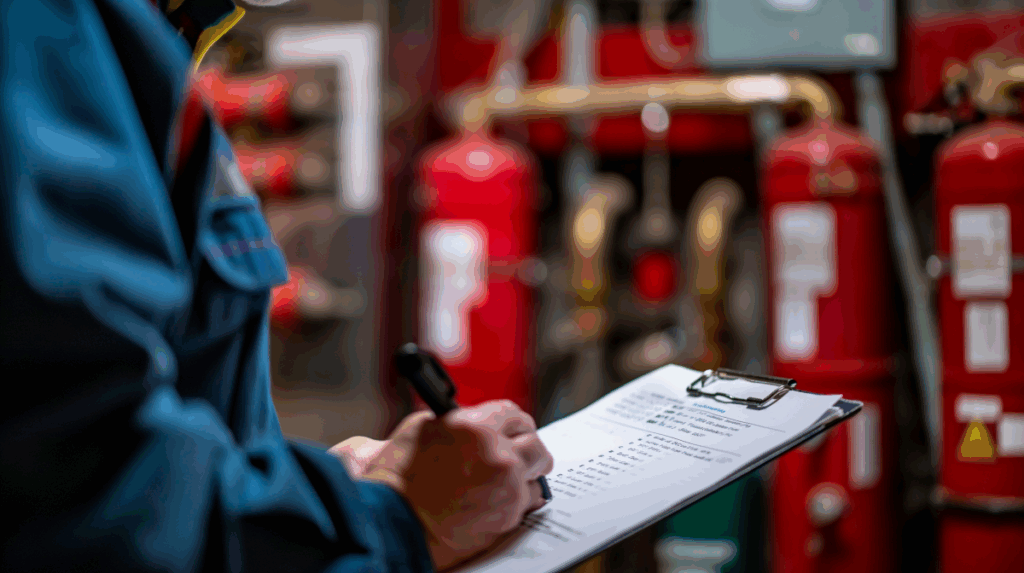
The National Fire Protection Agency (NFPA) requires frequent inspections and service for all parts of fire systems; usually monthly inspections and yearly service for each part of the equipment. Fire sprinklers are to be inspected each quarter and tested every year. Fire alarms are to be tested annually with monthly visual inspections. Fire extinguishers need monthly inspections and service each year. Local codes, system types, and other factors may alter the necessary frequency of services.
Why Inspection Frequency Is Crucial
Fire protection systems require inspection to confirm they will be operational when it counts. Pye-Barker licensed technicians find corroded sprinkler heads, dead alarm batteries, and low pressure reading on extinguishers during inspections. These problems can develop overtime, so regular inspections by licensed professionals can help address them from ever becoming a critical issue in a fire emergency.
The NFPA inspection frequency is based on real fire incident data and insights from years of experience with fire safety. Building owners, facility managers, and safety officers all comply with the NFPA’s guidelines to reduce the risk of system failure, protecting assets, businesses & people in the event of a fire-related emergency.
This guide covers the NFPA inspection frequency requirements for the three most common commercial fire protection systems: Fire Sprinklers, Fire Alarms, & Fire Extinguishers.
Fire Sprinkler Inspection Frequency (NFPA 25)
Sprinkler systems require control valve checks, quarterly inspections of gauges and components, and a full professional inspection with a flow test yearly.
NFPA 25 covers all water-based fire protection systems.
| Frequency | Component | What’s checked / performed | Who performs it |
| Monthly | Control valves | Visual check to confirm valves are completely open, properly sealed, and show no signs of tampering or leaks | Building staff |
| Quarterly | System gauges | Check to confirm pressure is within the normal operating range | Licensed technician* |
| Alarm valves, check valves & dry-pipe valves | External inspection for leaks and assessment of physical condition | ||
| Sprinkler heads | Visual inspection for corrosion and physical damage; confirm minimum 18-inch clearance beneath the deflector | ||
| Pipes and fittings | Check for leaks, corrosion, and mechanical damage | ||
| Annual | All system components | Full internal and external inspection by a licensed fire protection professional | Licensed technician* |
| Main drain | Flow test to verify adequate water supply | ||
| Alarm devices | Testing of flow switches, pressure switches, and water motor gongs | ||
| Fire department connection (FDC) | Check for debris and damage | ||
| Documentation | Complete records for the facility and the AHJ (if applicable) | ||
| Every 5 years** | System piping (internal) | Internal inspection per NFPA 25 to identify corrosion, tuberculation, or buildup that could restrict water flow without showing external signs | Licensed technician* |
*According to the NFPA 25 Code, inspection, testing, and maintenance shall be performed by qualified personnel who are registered, licensed or certified by a state or local authority.
**If the facility uses a warehouse fire protection system or any high-challenge suppression setup, staying up to date on the full NFPA 25 schedule is crucial given the complexity of the system.
Fire Alarm Inspection Frequency (NFPA 72)
Fire alarm systems need to be checked monthly by building staff and a full annual test by a licensed technician covering all detectors, notification devices, and monitoring pathways.
NFPA 72 assigns different testing intervals to different components, so a single system may have devices on monthly, annual, and multi-year cycles all at once.
| Frequency | Component | What’s checked | Who performs it |
|---|---|---|---|
| Monthly | Fire alarm control panel | No active trouble, supervisory, or alarm signals | Building staff |
| Notification devices | Horn/strobes and speaker/strobes physically intact | ||
| Pull stations | Unobstructed; tamper seals in place | ||
| Smoke & heat detectors (visual) | Free from dust and physical damage | ||
| Battery backup | No faults indicated | ||
| Annual | All initiating devices | Pull stations, smoke detectors, heat detectors, duct detectors, waterflow switches, tamper switches | Licensed technician |
| All notification appliances | Horns, strobes, speakers, mass notification components | ||
| Fire alarm control panel (full) | Primary and secondary power, trouble signals, firmware review | ||
| Central station monitoring | Verify alarm, trouble, and supervisory signals are received | ||
| Every 1–5 years | Smoke detector sensitivity | Sensitivity within listed range; clean, recalibrate, or replace if outside range. First test within year 1 of installation. |
Smoke Detector Sensitivity Testing
NFPA 72 requires smoke detector sensitivity to be tested within the first year of installation, and then at intervals of two to five years depending on the type of detector. Detectors outside the listed sensitivity range must be cleaned, recalibrated, or replaced to maintain effectiveness.
Fire Extinguisher Inspection Frequency (NFPA 10)
Fire extinguishers must be visually inspected monthly and professionally serviced annually. After 6 years, they require an internal exam. After 12 years, they require hydrostatic pressure testing.
| Frequency | Inspection type | What’s checked / performed | Who performs it |
| Monthly | Visual inspection | Accessible and clearly marked; pressure gauge in green; pull pin and tamper seal intact; no corrosion, dents, or discharge residue; legible label. Must be documented with date, location, and inspector initials. | Building staff |
| Annual | Professional maintenance | Weigh unit; inspect valve, hose, and nozzle; verify charge; replace pull pin and seal; recharge if needed; attach dated service tag. | Licensed technician |
| Every 6 years | Internal examination | Fully empty and disassemble stored-pressure units; inspect internals for wear, corrosion, and function. | Licensed technician |
| Every 12 years | Hydrostatic pressure test | Pressure-test the cylinder to verify it can safely hold charge. Units that fail are removed from service and destroyed. | Licensed technician |
For a full walkthrough of service intervals, lifespan, and when to replace vs. recharge, see Pye-Barker’s fire extinguisher maintenance and replacement guide.
Pye-Barker’s fire extinguisher service team handles all four levels — routine annual maintenance, 6-year internal exams, hydrostatic testing, and certified disposal.
Don’t Forget These Systems!
Many commercial buildings have additional systems with their own NFPA requirements aside from fire sprinklers, fire alarms, and fire extinguishers.
Kitchen Hood Suppression (NFPA 17A / NFPA 96)
Commercial kitchen hood suppression systems need to be inspected and serviced twice a year with monthly visual inspections. The accelerated schedule is due to the high-grease, high-heat environment that quickly breaks down nozzles, detection lines, and agent supply faster than standard conditions.
Fire Pumps (NFPA 25)
Fire pumps require a weekly no-flow (churn) test to confirm the pump works. An annual full-flow test is also required to verify that the pump delivers rated pressure and flow performance.
Pye-Barker’s fire suppression services cover special hazard and suppression system inspections across a wide range of facility types and industries.
How to Keep Your Inspection Schedule Under Control
Managing monthly, quarterly, semi-annual, annual, and multi-year intervals across multiple systems can be an operational challenge. Here are some tips to help maintain the schedule:
- Build a master inspection calendar. Map each required interval for every system to one place. Include due dates and who is responsible (in-house staff vs. Contractor).
- Name specific owners. Monthly visual inspections often fail because responsibility isn’t assigned to a specific individual.
- Use a single source provider. One licensed fire protection company handling sprinklers, alarms, extinguishers, and suppression systems results in fewer gaps, simpler scheduling, and cleaner documentation.
- Keep records accessible. AHJs and insurance carriers can request inspection records at any time. Digital records that are easy to pull are superior to a folder of paper service tags.
Pye-Barker Fire & Safety serves commercial and industrial customers nationwide. Find a location near you and connect with a licensed technician who can assess where you stand and help build a service plan around your specific systems.
The Real Cost of a Missed Inspection
- Code violations and fines during routine fire marshal inspections or after an incident
- Insurance complications — policies often require documented NFPA compliance; gaps can affect claim outcomes
- Failed occupancy inspections when bringing on new tenants or after renovations
- Legal liability if a fire occurs and uninspected equipment contributed to a failure
- OSHA citations for extinguisher and egress violations in workplace settings
Frequently Asked Questions
What documentation should be kept after a fire system inspection?
After an inspection, you should retain copies of inspection reports, testing records, deficiency notices, and maintenance documentation to demonstrate compliance and provide a history of system performance. These records may be requested during audits, inspections, or insurance reviews. Learn more about Code Compliance
Do inspection requirements vary by location?
Yes, inspection requirements do vary from location to location. Although NFPA standards establish minimum inspection frequencies, additional inspections or testing based on local codes, occupancy type, or building hazards may be required by your local Authority Having Jurisdiction (AHJ). Always verify requirements with your local AHJ. Learn more about Fire Alarm Testing Requirements
How can businesses stay on top of multiple inspection schedules?
Businesses can stay on top of multiple inspection schedules by working with a single fire protection provider. This can help maintain a proactive inspection calendar can help ensure all required inspections, testing, and maintenance activities are completed on time. Digital recordkeeping can also simplify compliance tracking across multiple systems.
What happens if a fire system inspection is missed?
Missing a required inspection can result in code violations, increased liability, insurance complications, business operation impacts and reduced system reliability during an emergency. To help identify issues, regular inspections help the performance of your fire protection systems.
Let Pye-Barker Manage It For You
Pye-Barker Fire & Safety provides comprehensive fire suppression inspection and repair services for facilities of every type and size. Our licensed technicians follow all NFPA codes & protocols, so nothing gets missed.
Pye-Barker handles it all under one service relationship.
This article is for general informational purposes regarding NFPA inspection frequency guidelines. Requirements vary by occupancy type, system configuration, and local jurisdiction. Always consult a licensed fire protection professional and your local AHJ for guidance specific to your facility.