For building owners and facility managers, understanding what a fire sprinkler inspection includes makes it easier to know what to expect, why each step matters, and how to stay ahead of compliance deadlines instead of scrambling to catch up.
Quick Answer: What Happens During a Fire Sprinkler Inspection?
A fire sprinkler inspection follows the requirements set out in NFPA 25 and includes checking control valves, gauges, sprinkler heads, piping, and water supply components to confirm the system will function properly in the event of a fire. Inspectors test alarm and flow devices, look for corrosion or physical damage, verify proper water pressure, and document everything in a formal inspection report. Inspection frequency ranges from quarterly to every several years, depending on the specific component being checked.
What Should Building Owners Expect From a Sprinkler Inspection?
Building owners can expect a licensed inspector to walk the property, physically check each major system component, run a series of standard tests, and provide a written report identifying anything that does not meet compliance. Routine inspections typically take a few hours for a commercial building, though larger or more complex properties with multiple systems may take longer.
Here’s what that process generally looks like, step by step.
Fire Sprinkler Inspection Checklist: Step by Step
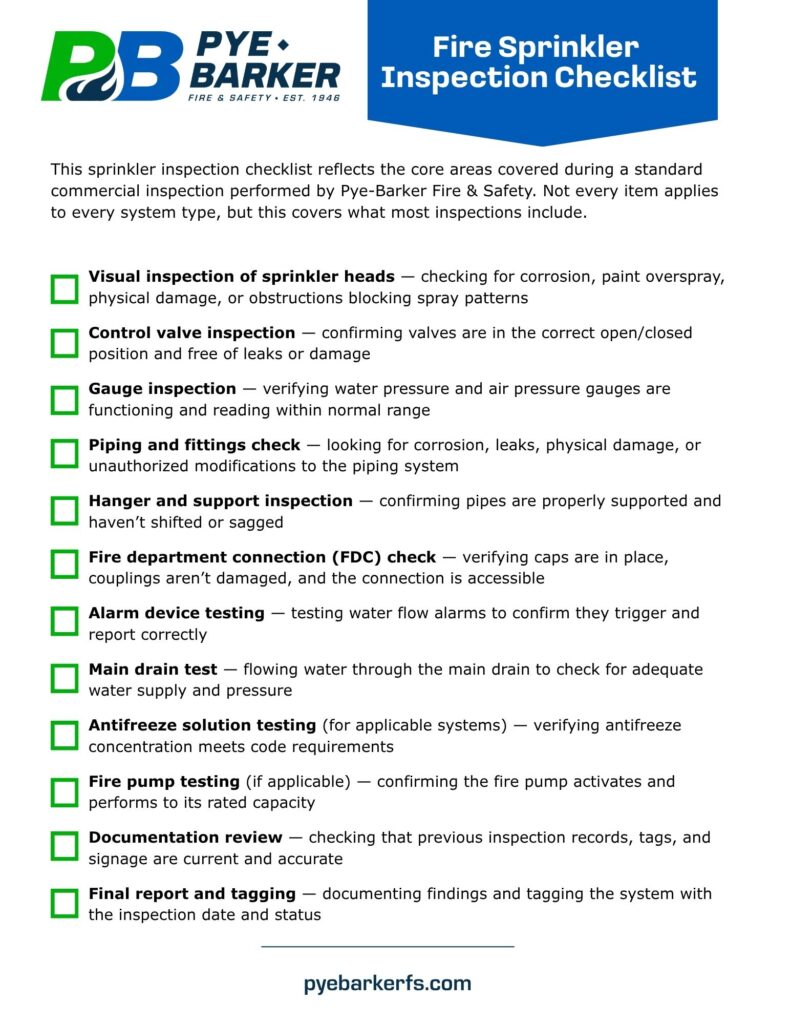
This sprinkler inspection checklist reflects the core areas covered during a standard commercial inspection. Not every item applies to every system type, but this covers what most inspections include.
- Visual inspection of sprinkler heads — checking for corrosion, paint overspray, physical damage, or obstructions blocking spray patterns
- Control valve inspection — confirming valves are in the correct open/closed position and free of leaks or damage
- Gauge inspection — verifying water pressure and air pressure gauges are functioning and reading within normal range
- Piping and fittings check — looking for corrosion, leaks, physical damage, or unauthorized modifications to the piping system
- Hanger and support inspection — confirming pipes are properly supported and haven’t shifted or sagged
- Fire department connection (FDC) check — verifying caps are in place, couplings aren’t damaged, and the connection is accessible
- Alarm device testing — testing water flow alarms to confirm they trigger and report correctly
- Main drain test — flowing water through the main drain to check for adequate water supply and pressure
- Antifreeze solution testing (for applicable systems) — verifying antifreeze concentration meets code requirements
- Fire pump testing (if applicable) — confirming the fire pump activates and performs to its rated capacity
- Documentation review — checking that previous inspection records, tags, and signage are current and accurate
- Final report and tagging — documenting findings and tagging the system with the inspection date and status
Download a copy of our
Fire Sprinkler Inspection Checklist
by clicking HERE!
Specific testing intervals defined by NFPA 25, means that not every item above gets checked every time.
How Often Each Component Gets Checked
One of the more confusing parts of sprinkler inspection for building owners is that different components are inspected on different schedules:
- Quarterly — control valves, gauges, and water flow alarm devices
- Annually — full visual inspection of sprinkler heads, piping, hangers, and a main drain test
- Every 5 years — internal piping inspection to check for obstructions or corrosion buildup
- Every 5–10 years — fire sprinkler testing for things like sprinkler head sampling and full flow tests, depending on system type and age
This tiered schedule exists because some components, like control valves, need frequent eyes on them, while internal piping conditions change more slowly and don’t need to be inspected every year. A consistent inspection partner can track all these intervals so nothing falls through the cracks.
What Is Checked in a Sprinkler Inspection Report?
After the physical inspection is complete, everything gets documented in a formal sprinkler inspection report. This report should include:
- Date of inspection and the name/certification of the inspector
- A list of every component checked, with pass/fail status for each
- Photos or notes on any deficiencies found
- Recommended repairs or corrective actions, if applicable
- Confirmation of code compliance status (NFPA 25 and local AHJ requirements)
- A record of test results, including main drain test readings and alarm response times
Fire marshals, insurance carriers, and property managers all rely on these reports. Building owners should receive a copy after every inspection and keep the documentation on file for future reference, audits, or insurance purposes. Many inspection providers also offer secure digital inspection reports and electronic recordkeeping, making it easier to access historical inspections, share documentation with authorities having jurisdiction (AHJs), and maintain compliance records over time.
What Happens If an Inspection Reveals a Problem?
When an inspection results in finding an issue, the report will flag the specific deficiency, for example, a corroded pipe section. Depending on the severity, the inspector may recommend:
- Immediate repair before the system can be considered code-compliant
- A follow-up inspection once repairs are completed
- Temporary measures if the system is out of service until repairs are made
Catching these issues during a routine inspection rather than during an actual fire event is the entire point of the process. A deficiency that’s flagged and fixed costs far less time, money, and risk than one that’s discovered when the system fails to perform.
Why Routine Inspection Matters Beyond Compliance
It’s easy to think of sprinkler inspection purely as a compliance requirement something to check off so a fire marshal doesn’t issue a violation, but it also helps with:
- Insurance — Many commercial insurance policies require current inspection documentation to maintain coverage or qualify for better rates
- Liability protection — Documented inspections demonstrate that a property owner took reasonable steps to maintain a functioning fire protection system
- System longevity — Catching small issues like minor corrosion early prevents larger, more expensive repairs down the line
- Actual fire protection — Most importantly, a properly inspected system is far more likely to perform correctly if there is a fire event
For more detail on how ongoing inspection, repair, and compliance work together, see Pye-Barker’s fire suppression inspection, repair, and compliance services.
How Sprinkler Inspection Fits Into a Broader Fire Protection Plan
Sprinkler inspection is typically just one piece of a building’s overall fire protection program. Many commercial properties also need:
- Regular fire alarm testing to keep detection and notification systems compliant
- Coordination between sprinkler and suppression systems in buildings that use both for example, facilities with specialized hazards covered in the difference between fire sprinkler and fire suppression systems
- Employee training so staff understand how to respond if a system activates
Coordinating inspection schedules across all these systems with a single provider makes it easier to stay compliant without juggling multiple vendors and deadlines.
What to Look for in a Sprinkler Inspection Provider
Not every inspection company offers the same level of service. When choosing a provider, building owners should look for:
- Licensed, certified inspectors familiar with NFPA 25 and local AHJ requirements
- Clear, detailed inspection reports not just a pass/fail checkbox
- Proactive scheduling that tracks quarterly, annual, and multi-year requirements automatically
- The ability to handle both inspection and any necessary repairs, rather than requiring a separate company for fixes
- Experience across multiple system types and building occupancies
A provider that combines installation, inspection, and repair under one roof can also simplify the process further: see Pye-Barker’s fire suppression systems and installation services and fire protection pre-engineering, design, and installation for how these pieces connect from initial system design through years of ongoing service.
Pye-Barker Fire & Safety has certified inspectors who are trained on NFPA 25 and local AHJ requirements, and every inspection comes with a detailed report. We proactively track quarterly, annual, and multi-year service intervals, and handle installation, inspection, and repair all under one roof.
Schedule a Fire Sprinkler Inspection
Whether a system is overdue for inspection or a building owner simply wants a reliable partner to manage recurring testing, Pye-Barker Fire & Safety provides inspection, testing, and compliance documentation for commercial sprinkler systems.
Frequently Asked Questions
What happens during a fire sprinkler inspection?
A fire sprinkler inspection includes a physical check of sprinkler heads, control valves, gauges, piping, and hangers, along with testing of alarm devices and a main drain test to confirm proper water flow and pressure. Inspectors document findings in a formal report and flag any deficiencies that need repair.
What should building owners expect?
Building owners should expect a licensed inspector to walk the property, test key system components, and provide a written inspection report with pass/fail results for each item checked. If any deficiencies are found, the report will outline recommended repairs and next steps.
How often does a sprinkler system need to be inspected?
Inspection frequency varies by component. Control valves, gauges, and alarm devices are typically checked quarterly, a full visual inspection and main drain test happen annually, and certain internal piping and flow tests are required every five to ten years.
What is included in a sprinkler inspection report?
A sprinkler inspection report includes the inspection date, inspector information, a component-by-component pass/fail summary, notes or photos on any deficiencies, recommended corrective actions, and confirmation of code compliance status.
What happens if a sprinkler inspection reveals a problem?
If an inspection identifies a deficiency, the report will note the specific issue and recommend repair. Depending on severity, the system may need immediate repair, a follow-up inspection, or temporary measures like a fire watch until the issue is resolved.